
The pairing that holds in HPV-negative head and neck
Ficerafusp alfa pairs deep and durable responses in HPV-negative head and neck. A structural read of why the two arrive together, a dated below-even call on the trial that decides Bicara, and the stratification nobody has put on the table.
There is a number in the ficerafusp alfa data that does not sit where it should. In the first expansion cohort, 28 patients with HPV-negative recurrent or metastatic head and neck cancer, CPS at least one, the combination of ficerafusp alfa and pembrolizumab produced a 64% overall response rate. Pembrolizumab on its own, in the same population, lands near 19%. That gap is one thing. The depth is another: among the responders, roughly 80% had tumours shrink by 80% or more, and the median duration of response ran past 21 months.
Deep and durable at the same time.
Combination immunotherapy usually gives you one or the other. You get deep responses that fade, because the cell economy of a tumour catches up and the response is paid back over the following year. Or you get durable responses that are shallow, because only the patients already primed to respond convert, and they convert partway. The two qualities trade against each other often enough that seeing them together is unusual, and here they show up in a population where a single checkpoint gets a fifth of patients to respond at all.
Bicara presented three-year follow-up at ASCO this year, pooling about 90 patients across the 750mg weekly, 1500mg weekly, and 2000mg every-other-week cohorts. At the 1500mg dose the estimated three-year overall survival came in around 31%, roughly double a retrospective standard-of-care comparison. The company's own pooled analysis reported that the deepest responders were the ones who stayed progression-free and alive the longest, and pointed at TGF-β neutralisation as the thing driving it. The pairing did not decay over three years. It held.
Three years of follow-up settles that the pairing is real. The open question is the mechanism: why depth and durability arrive together here, when the usual machinery of immunotherapy produces them apart.
What the trap takes down
Ficerafusp alfa is one antibody doing two jobs, and only one of them is about the immune system. The EGFR arm is the kind of thing cetuximab has done in head and neck cancer for two decades. It debulks the tumour and brings some antibody-dependent killing, working on the cancer cell directly, sitting mostly outside the immune cycle. The other arm, the trap that binds TGF-β and holds it, is the one that does the immune work, and the story usually told about it is too small. Soaking up TGF-β does take a brake off the T cells. It also acts at points the brake never reaches, and those points are where the depth and the durability come from.
HPV-negative head and neck cancer is, in a lot of patients, a tumour where the immune cells and the cancer cells are kept in separate rooms. The T cells are present. They sit in the surrounding tissue and the myeloid cells keep them out of the tumour bed. TGF-β is one of the signals doing the keeping-out, and it works at other points too. Further back it holds dendritic cells from maturing, so the response is underbuilt before it starts. Further forward it feeds the regulatory T cells that suppress whatever does get through. A checkpoint inhibitor releases a brake at the synapse. It does nothing about a response that was underbuilt before it started, kept out of the tumour bed, and suppressed once it got in.
So pembrolizumab and the TGF-β trap are working in different places. Pembrolizumab releases the synapse brake, the one position checkpoint blockade has always acted on. The trap relieves the exclusion upstream and the suppression downstream that the brake-release never reaches. The combination occupies a span of the cycle that pembrolizumab alone leaves open, in a tumour where TGF-β-driven exclusion is a documented block on response (NPJ Precision Oncology, 2021). This is coverage: the reach of a combination is how many of the cycle's positions it occupies, and these positions do not overlap.
That spread is a way to read the depth and the durability together. More of the suppression is lifted at once, so more patients convert and the ones who convert go deeper. The relief rests on several positions rather than a single lever, so the tumour cannot route around it by undoing one thing the way it learns its way around a lone brake-release in months.
The three-year update
The three-year data confirmed the pairing. It also showed Bicara framing the result the same way this reading does.
The confirmation is the three years of durability and the pooled finding that depth predicts who lasts. The framing Bicara now uses, depth of response as a surrogate for long-term outcome, is the depth-durability pairing named in their own terms. A year ago the pairing was a striking set of numbers in a small cohort. Now it is a longitudinal finding the company builds its surrogate argument on. The two posters at ASCO, Wong and colleagues on TGF-β trapping driving sustained depth, Kaczmar and colleagues on depth of response predicting outcome, both make the case that depth is what to track.
The part still unsaid is the one that matters for the trial that decides the company. If the benefit comes from lifting TGF-β-driven exclusion and suppression, then the deepest responders should be the patients who carried the most of it to lift. Depth should track a TGF-β exclusion signature, the myeloid-exclusion and suppression burden in the tumour bed, more closely than it tracks PD-L1 CPS. CPS reads something about the brake at the synapse and close to nothing about the exclusion. The mechanism the company now credits for the durability, TGF-β neutralisation, is a claim about that exclusion and suppression. The stratification that follows from it, sorting patients by how much of it they carry at baseline, is the one nobody has put on the table.
This is a prediction, and it has a clean way to be wrong. Take the Phase 1b paired-biopsy material, stratify depth of response by a baseline TGF-β exclusion signature, and if depth tracks CPS more tightly than it tracks that signature, the reading here is wrong. Ficerafusp alfa would then be a strong EGFR antibody that happens to combine well with a checkpoint inhibitor, and the multi-position story would be decoration. That is the falsifier, checkable in data Bicara already holds, with one re-stratification of patients they have already biopsied.
The decision sitting inside the trial
FORTIFI-HN01 is enrolling now. It is a Phase 2/3 study, around 650 patients, first-line HPV-negative recurrent or metastatic head and neck cancer, and it admits patients on a PD-L1 CPS of at least one. The co-primary endpoints are overall response rate and overall survival. The interim analysis is expected in the middle of 2027, gated on getting to substantial enrolment by the end of this year. The trial sorts patients by CPS. It does not sort them by the TGF-β exclusion axis.
If depth tracks the exclusion axis rather than the brake, a CPS-admitted, CPS-read trial is carrying two populations that do not behave the same way. The patients with a heavy exclusion burden are the ones the mechanism predicts will respond deepest and longest. They are in the trial already, mixed with patients admitted on a CPS number that does not see the exclusion at all, and a real effect in the first group can be pulled toward the null by the second.
There are two ways to act on that, and both use tissue Bicara already holds. The cheap one is a pre-specified analysis: score every enrolled patient for a baseline TGF-β exclusion signature, lock the cutoff before the readout, and report the survival effect in the exclusion-high group beside the all-comers result. It does not touch the primary analysis. It gives a dated place to look when the all-comers number comes in soft, and it shows where the benefit sits either way. The stronger one is an enrichment amendment, making the exclusion-high group a formally tested co-primary population while enrolment is still open. The pre-specified analysis tells you where the benefit was. The amendment, made in time, can put the benefit into the primary result. Both are reachable now. Once the trial is enrolled and read on CPS alone, the question is answered by absence, and absence is harder to act on.
Beating pembrolizumab on overall survival in first-line head and neck is a bar that has killed combinations with rationales as clean as this one. The closest precedent reads as a warning. Bintrafusp alfa, the same bifunctional idea of a TGF-β trap bolted to a checkpoint, produced signals in several tumours and converted none of them into a Phase 3 win. A strong single-arm response rate and a tidy multi-position story are exactly what that graveyard also had. So the trial reading out is a real question on its own, before the stratification question is reached. The stratification question is the one that survives either answer. If the benefit is real, the design should be positioned to show where it lives, and on CPS alone it is not.
How the reading was made
The published response rates put each agent at a place in the cycle. Pembrolizumab acts at one position, the brake at the synapse. The TGF-β trap acts at several others, the exclusion and suppression points the brake never reaches. The EGFR arm works on the tumour cell and sits mostly outside the immune cycle. That cycle, and the coverage rule that turns a map of where each drug acts into a direction, come from Persistence Dynamics (van der Klein, 2026), the account of how any dissipative system holds itself together. The same four-regime shape runs whether the system is an immune response or anything else that persists, and cancer immunity is one instance of it. Read that way, the combination covers a span pembrolizumab alone leaves open, and that is the favourable half of the read.
The other half is the precedent. A coverage rationale scores how much of the cycle a combination occupies. It does not, on its own, know that the same bifunctional idea has been tried before and has lost. That comes from outside the framework. The in-platform record on TGF-β-pathway trials is empty, the record on checkpoint combinations is a coin flip across two resolved cases, and the external record on TGF-β-trap-plus-checkpoint bifunctionals is a run of Phase 3 failures. Set the coverage rationale against that precedent and the forecast lands a little below even, held up by the mechanism and pulled down by the class record.
The one load-bearing piece of the read, that CPS is the wrong axis, we took somewhere it could be checked against real patients. There is a single-cell breast cohort treated with anti-PD-1 where the warm-tumour signature, the activated effector markers, ran opposite to who responded, while an upstream availability measure separated responders from the rest. It is a different cancer with a different limiting step, and the finding is the same: activation markers do not sort response. That is support for the direction, from a cohort that has nothing to do with head and neck, and it is sideways support, because that cohort carries no TGF-β exclusion measurement and so cannot test whether the exclusion signature is the right axis, only whether activation is the wrong one. The specific prediction waits on the data Bicara already holds.
What this is
Encounter publishes readings like this one on a fixed discipline. The call is dated, it is made before the trial reads out, and it carries its own falsifier. The quantified version sits on the trial's page at theory.encounter.bio/t/NCT06788990, dated, with its evidence and the line that would prove it wrong. It leans toward a miss on the overall-survival endpoint, a probability a little below even, and it will be scored against the trial when it reports. Saying it now, in June 2026, with the readout still ahead and enrolment still open, is what makes it a claim rather than a comment on a result already in hand.
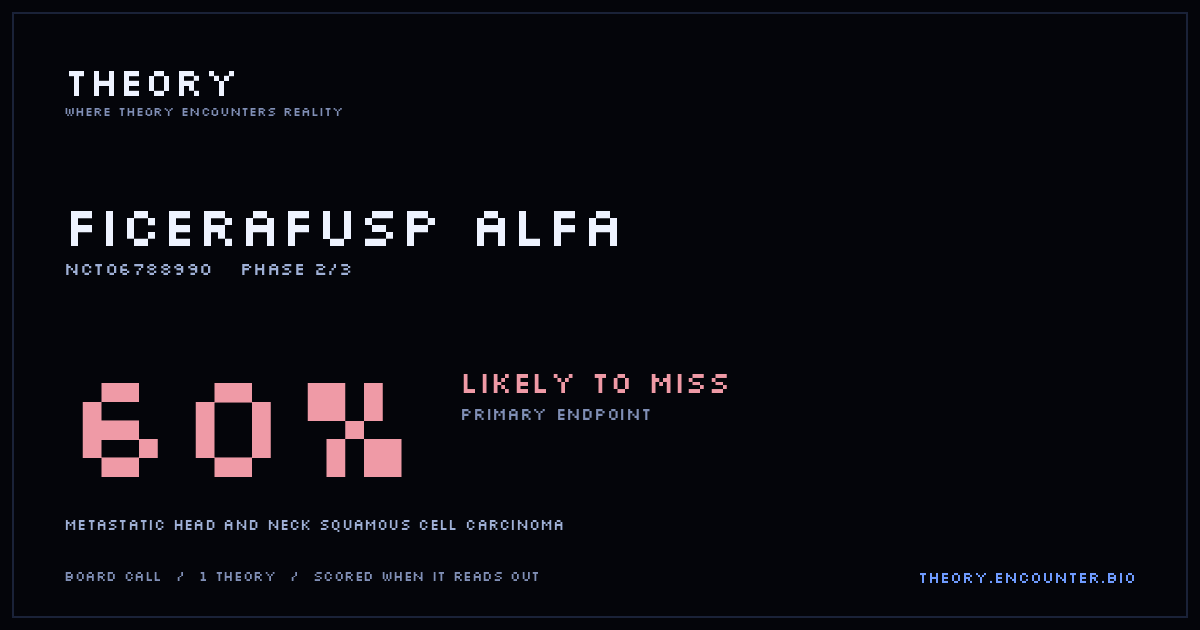
So here is the question that hangs over the whole company, said plainly. Bicara has one asset, and one randomized readout decides it. Ficerafusp alfa has to beat pembrolizumab on overall survival in first-line head and neck, and no bifunctional of this kind has ever cleared that bar. The trial built to answer it sorts patients on CPS, a read on the brake, in a drug whose benefit the mechanism places on the exclusion axis instead. The existential question and the stratification question are the same question. The most likely way a working drug fails here is by being measured where it does not work. The months before the trial locks are the last chance to put the measurement where the benefit is.